10 minute read
Texting for Giving Tuesday: What to Send and When to Start in 2026
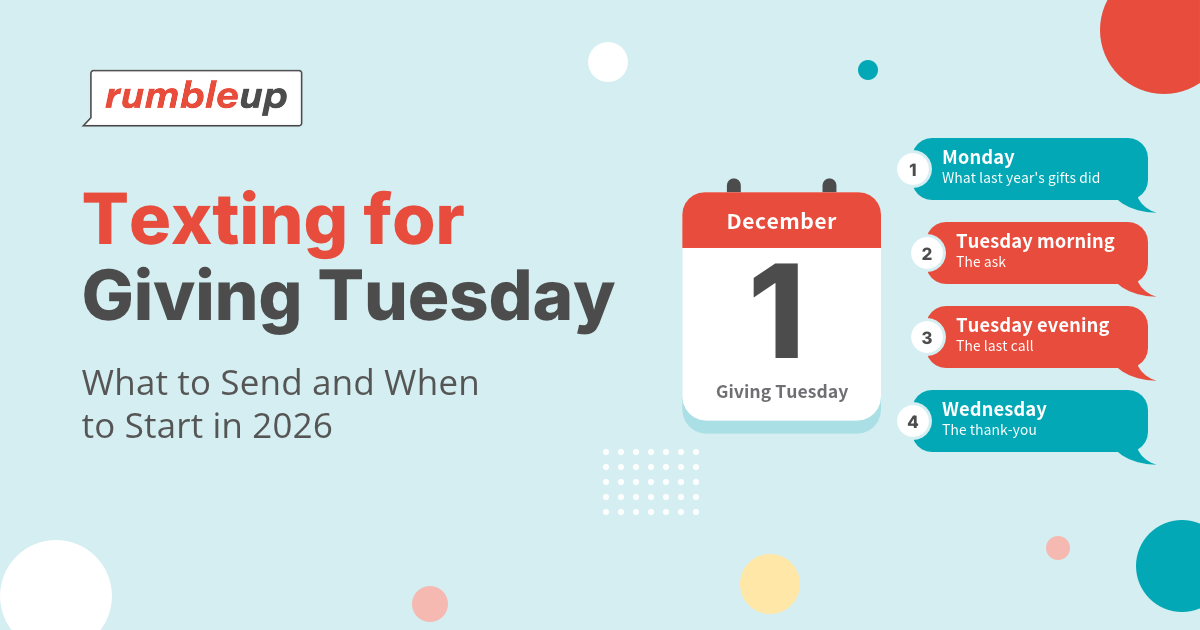
Giving Tuesday 2026 is December 1st. See which four texts to send donors, when to send them, what they cost, and how to register your number in time.
Giving Tuesday started in 2012 with a small team at the 92nd Street Y in New York. Black Friday and Cyber Monday were two days of shopping, and the team wanted to follow them with "a day that encourages people to do good," as GivingTuesday describes the idea. Donors gave roughly $10 million online that first year, Fast Company reported.
In 2025, donors in the U.S. gave $4.0 billion on Giving Tuesday, up 13% from 2024, according to the GivingTuesday Data Commons.
Giving Tuesday 2026 is Tuesday, December 1st. On that day, your appeal will reach donors alongside appeals from the other organizations they support on increasingly saturated channels.
Nonprofits are also sending more email and spending more on ads. In 2025, they sent each email subscriber an average of 50 messages, 15% more than in 2024, and spent an average of 18% more on digital ads, according to the M+R Benchmarks Study. They sent their active donors about 15 mailings that year, the same study found. The donors you call got their share of the 52.5 billion robocalls U.S. consumers received in 2025, according to the YouMail Robocall Index.
To break through all that noise, we recommend sending your ask to your donors' text inboxes as well in a series of short text messages: one that shows what last year's gifts paid for, the ask on Giving Tuesday morning, a last call before the midnight deadline, and a thank-you with the total the next day if you care about turning a one-time donor into a recurring one.
If your nonprofit has donors’ cell numbers and has never texted them, you can still add texting to this year's plan. Carrier registration takes an average of 2 to 5 business days, so start it now.
At RumbleUp, we know adding a new channel this close to Giving Tuesday can be a hard sell to your board or decision-makers when your budget or plan is already committed. Our Giving Tuesday offer for new accounts is built to make that conversation easier. It runs through December 1st and includes a Positive ROI Guarantee, three months with no platform fee, and 1,000 free text messages.
We also wanted to address the questions we hear most often from nonprofits about Giving Tuesday texting, which we have covered below.
Why text donors when you already use email, direct mail, and live phone calls?
Media has never been more fragmented, and no single channel reaches all of your supporters. A donor who gives by check when a letter arrives may never open your email, and a donor who answers every text may never see the letter. Make your Giving Tuesday appeal on as many channels as your team can run well to maximize your chances of reaching each supporter where they prefer.
Each of those channels has its own strengths and weaknesses:
|
Channel |
What it does well |
Where it falls short on December 1st |
What the numbers show |
|
|
Has room for the full story, photos, and several links |
Arrives with every other appeal, and it is increasingly difficult to make it out of promotions and spam folders |
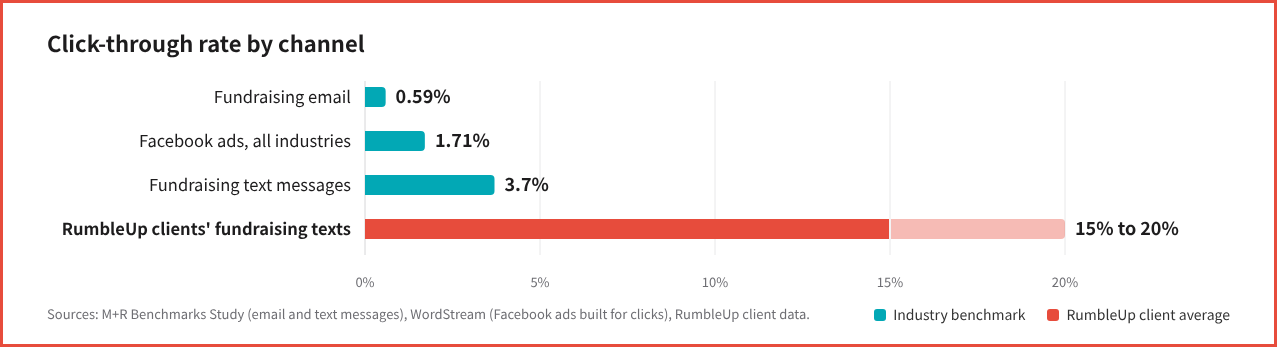
0.59% click-through rate on fundraising emails (M+R) |
|
Direct mail |
Puts a reply envelope in the hands of donors who give by check |
Has to go out days ahead, so it cannot report progress or announce a late match |
$120 average gift, and $4.51 returned for every $1 spent on mailings to active donors (M+R) |
|
Phone calls |
Give a donor a chance to speak with a real person live |
Reach one donor at a time, and pickup rates have been falling steadily for years |
About 80% of calls from numbers people do not recognize go unanswered (Hiya) |
|
Digital ads |
Reach new supporters who are not on your email or text lists |
Charge for every click, and the donor cannot engage with your team if they have questions or concerns |
1.71% click-through rate on Facebook ads built for clicks, across industries (WordStream) |
|
Text messages |
Go out the moment you have news, link to your donation page, and let the donor write back |
Reach only the donors whose cell numbers you have, at a few cents each |
3.7% click-through rate on fundraising text messages (M+R). Our own clients average 15% to 20% click-through rates on fundraising text messages, and we have seen rates as high as 50%. |
Keep every channel you already use, and add text messages at the four points where timing matters most: the day before, the morning ask, the last hours before your deadline, and the thank-you.
Texting fits this year if you have cell numbers for your donors, your donation page works on a phone, and one or two people can answer replies on December 1st. If you don't have cell numbers on file, now is a great time to start collecting them for your year-end appeals.
How does texting work for a Giving Tuesday appeal?
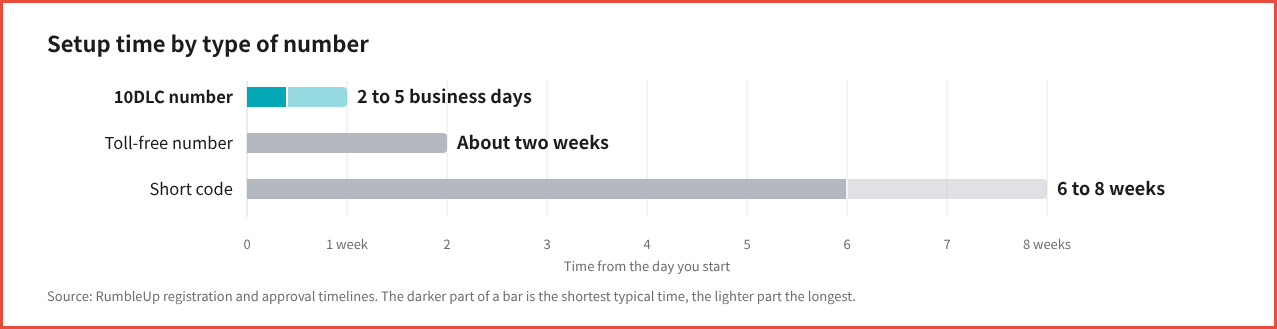
Organizations text from one of three types of numbers, and each takes a different amount of time to set up.
-
A 10DLC (10-Digit Long Code) number is a standard 10-digit number, often with a local area code, that you register for organizational texting. It costs the least to set up, registration takes an average of 2 to 5 business days, and it suits conversational texting, where donors reply to a person on your team.
-
A short code is a 5- or 6-digit number built for high-volume, long-running programs, and carrier approval typically takes 6 to 8 weeks.
-
A toll-free number is a business-style number that suits service and support messages, and setup usually takes about two weeks.
A short code cannot be approved before December 1st, and a toll-free number almost certainly can't be approved either, so use a 10DLC number for this year's appeal. To choose the best fit for your program after Giving Tuesday, read how short code, 10DLC, and toll-free numbers compare in our short code guide.
A Giving Tuesday SMS fundraising campaign on any type of texting line takes four things: a short series of texts, a few rules, a carrier registration, and a small budget.
How many Giving Tuesday texts should you send, and when?
Send four texts: three by midnight on Giving Tuesday and a thank-you the next day. That is the whole campaign timeline for a nonprofit starting now. Time each text around the emails, mail, and ads you already have planned.
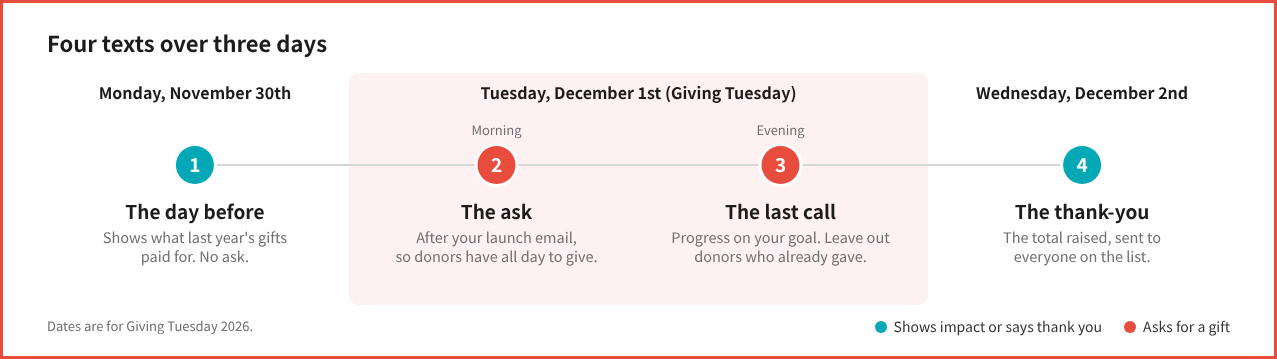
A Giving Tuesday text opens with a name and the organization, says what a gift pays for in dollars, and includes one donation link. Link every text to the same Giving Tuesday page your emails, ads, and social posts use, so donors see the same goal and the same total wherever they come from.
One RumbleUp client sent about 10,000 previous donors a three-part series in the weeks before year-end. The early texts included a video reminding donors why they support the organization, and the last text asked for a gift that a year-end matching grant would double. Thirty-seven donors gave $4,000, an average gift of more than $100, as we reported in a 2019 roundup of client results.
The texts below follow the same progression for a fictional food pantry with a $15,000 goal and a $15,000 match. Swap in your own program, fundraising goals, and names. The official GivingTuesday toolkit has sample emails and social posts to send alongside them.
1. The day before: Monday, November 30th
Send a text that shows what last year's gifts paid for and asks for nothing except their attention. We recommend Monday for two reasons. You avoid competing with the worst of the Black Friday and Cyber Monday advertising onslaught, and your organization is still fresh in donors' minds when the ask arrives the next morning. Send this text a week or two earlier, and donors may struggle to remember you by Giving Tuesday.
Do not skip this text. It shows donors what last year's gifts accomplished right before you ask for this year's gift, which gives them a reason to give again. If a donor is offering matching gifts, announce the match in this text and repeat it in the ask.
|
"Hi [First Name], this is [Staff Name] with [Organization]. Gifts on Giving Tuesday last year paid for 1,200 hot meals at our Oak Street kitchen. Tomorrow is Giving Tuesday, and a board member will match every gift up to $15,000. You can see what the match will fund at [Link]." |
2. The ask: Tuesday morning, December 1st
This is the ask, or launch-day text. Send it in the morning, so donors have the whole day to give, and after your launch email goes out, so donors who want the full story can find it in their inbox.
|
"Good morning [First Name], this is [Staff Name] with [Organization]. Today is Giving Tuesday. Our goal is $15,000 by midnight for the winter meal program, and every gift is matched. $25 pays for a week of groceries for one family. You can give at [Link]." |
If you have no match, send this version:
|
"Good morning [First Name], this is [Staff Name] with [Organization]. Today is Giving Tuesday. $25 pays for a week of groceries for one family, and our goal is 600 weeks of groceries by midnight. You can give at [Link]." |
3. The last call: Tuesday evening, December 1st
Send a last call with a progress update on your goal. Before you send it, check your donation platform for every gift, whether it came from a text, an email, an ad, or the QR code on a mailer, and leave people who have already given out of the last call.
That one piece of audience segmentation saves you money and spares donors a second ask that can be perceived as a lack of care for the action they already took.
|
"[First Name], this is [Staff Name] with [Organization] again. We are $2,300 short of today's goal, and the match ends at midnight. If you planned to give, the page is [Link]. Thank you either way." |
4. The thank-you: Wednesday, December 2nd
Send a donor thank-you with the total raised to everyone on the list, then follow up with an email that includes the full story and results.
|
"Hi [First Name], this is [Staff Name] with [Organization]. Yesterday 412 people gave $18,940, and the match added another $15,000. That pays for the winter meal program through March. Thank you. I will send photos in January when the first deliveries go out." |
Keep that promise. Send the January update, and ask about recurring gifts then. If a year-end mailing is still going out, move Tuesday's donors to a thank-you version of it.
Important consideration: reply management
For those seeking to turn one-time donors into recurring donors, which should be everyone reading this, replying to build relationships and trust is a must. Donors WILL text back, and that requires a staffing decision.
A supporter who asks a question getting in the way of a successful donation at 6 p.m. on Tuesday evening should have an opportunity to get an answer before the match expires. You should have a clear plan for incoming questions with a staff member or volunteer monitoring replies, especially when a donor needs help completing a gift.
You can anticipate most of the replies you will receive, because they follow from your organization's circumstances and the specifics of your campaign. We recommend writing your answers ahead of time, so everyone on your team responds in your organization's voice.
Here are some examples of common replies to get your list started:
|
Donor reply |
Your answer |
|
"Is this real?" |
"Yes, this is [Staff Name] with [Organization]. You can confirm our Giving Tuesday campaign at [website] or call our office at [phone number]." |
|
"How do I give?" |
"The fastest way is [Link]. You can also mail a check to [address]." |
|
"I already gave." |
"Thank you, [First Name]. I see your gift, and I will leave you off tonight's reminder." |
On our nonprofit texting platform, volunteers answer from a team inbox with tap-then-send responses, and tags mark donors to exclude from the later sends.
With more time next year, add a save-the-date text and a countdown text. Our six-touch Giving Tuesday sequence starts in October and saves the ask for Giving Tuesday.
What texting rules should nonprofits follow?
Start with three practices on every send:
-
Name yourself and your organization in every message.
-
Give opt-out instructions in every text for 10DLC numbers, or just the first text for toll-free and short code numbers, and remove anyone who replies STOP - ideally your texting platform should remove them for you (we do).
-
Send between 8 a.m. and 9 p.m. in the donor's local time, the window federal rules set for telephone solicitations.
Some states add their own rules. This is general guidance - your attorney can advise you on more specifics.
Is there still time to start before Giving Tuesday?
Yes, if you start carrier registration now. Carriers require 10DLC registration before an organization texts from a standard 10-digit number. Plan on 2 to 5 business days once you meet the requirements, the timeline RumbleUp publishes for nonprofit registrations. Thanksgiving is not one of those days.
Our registration and messaging activation timeline (PDF) lists each step, how long it takes, and what to have ready. The nonprofit timeline is on page 2.
To make your registration as seamless as possible, have five things ready:
-
Your EIN
-
Your legal name and address, as the IRS has them
-
Your IRS determination letter (501(c) only)
-
A live website with a compliant privacy policy page
-
Example messages
If your registration clears after November 30th, skip the first text and start with the ask. You can also use the same number in December for general year-end giving appeals, when nonprofits received 37% of their 2025 online revenue, according to M+R.
What does it cost, and how do you show your board it worked?
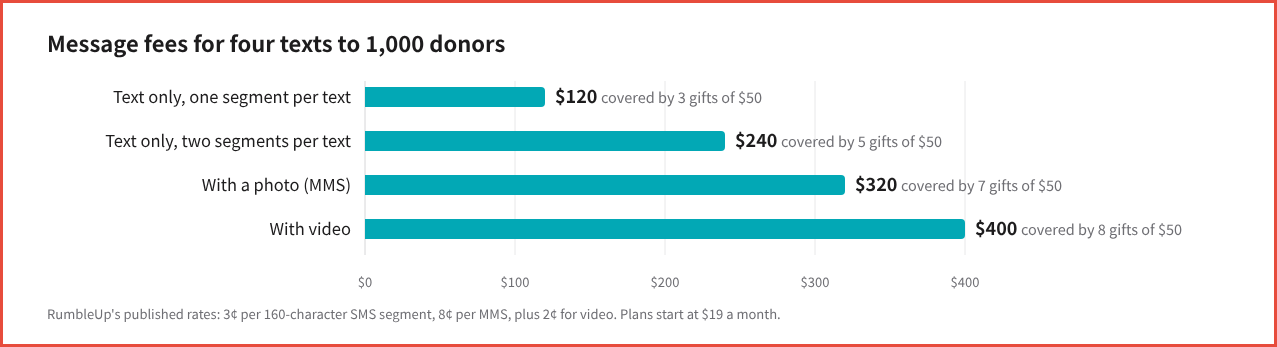
Four texts to 1,000 donors cost between $120 and $400 in message fees, depending on length and whether you add a photo or video. That range uses our published rates of 3¢ per 160-character SMS segment and 8¢ per MMS, plus 2¢ for video, and eight $50 gifts cover the high end. Plans start at $19 a month, and carrier registration fees pass through at cost.
Report gifts first and clicks second. Use trackable links, a separate one for each text, and bring your board three numbers after December 2nd: gifts and dollars from those links, dollars raised for every dollar spent on messages, and the number of donors who replied. For a benchmark, M+R's average for text message fundraising is 37 clicks for every 1,000 texts.
Before the first send, make a $5 test gift on a phone to confirm that your mobile donation page works and the gift shows up under the right link.
Bonus tips for teams that run ads and analytics
Skip this part if no one on your team works in your ad accounts or Google Analytics. The four texts work without it.
-
Give the links in your texts, emails, and ads their own UTM tags, so Google Analytics shows which channel each visitor came from.
-
If the Giving Tuesday page your texts link to has your Meta Pixel or Google tag installed, donors who arrive from a text join the retargeting audience your ads reach on Tuesday.
-
Turn on click tracking for the links in your texts. By Tuesday evening, you will know who clicked or replied without giving, and you can send the “last call” text only to those donors.
-
On Wednesday, upload your Giving Tuesday donors to your ad platforms and exclude them from your year-end campaigns, so you stop paying to ask people who just gave.
How does RumbleUp help you text donors by December 1st?
Our team sets you up on one 30-minute strategy call. You leave with a send calendar, messages drafted in your voice, and your 10DLC registration underway at carrier cost with no markup. Every reply comes to a person on your team, and our support team works seven days a week.
Organizations that meet with our team before December 1st, 2026, and open a new RumbleUp account by 11:59 p.m. ET that day get our special Giving Tuesday offer:
-
A Positive ROI Guarantee that refunds the difference if the donations your texts raise come in under what you spent on messages
-
The $19 monthly platform fee waived for your first three months
-
1,000 free text messages once your registration clears
The guarantee covers the sequence you set with our team on the call, sent in order and on schedule, with your donation totals shared by December 15th, 2026. If you write and schedule your own messages, you keep the fee waiver and the free texts. Existing accounts do not qualify.
With or without the offer, you get RumbleUp, a texting platform trusted by 3,500+ clients nationwide, with a 95% customer retention rate.
Interested in trying texting? There are two ways to move forward: visit our Giving Tuesday offer page and schedule a call with our team to take advantage of the offer, or open your RumbleUp account. Either way, start now so your first text is ready for November 30th.
 10 minute read