 9 minute read
How to Get New Donors in 2026 With Relationship-First Texting Sequences for Campaigns and Nonprofits
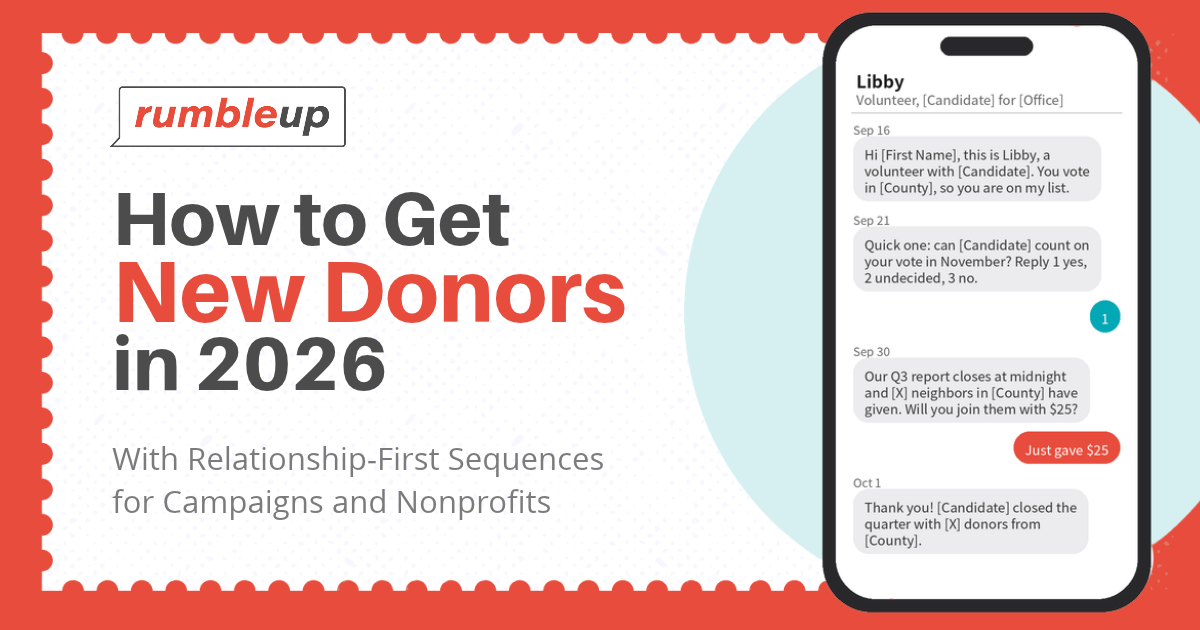
Donor counts fell five straight years while dollars rose. Get a six-touch texting sequence, with example messages, for Q3 close, Election Day and GivingTuesday.
Fundraisers that successfully attract new donors this year know that building relationships must come before asking them to fork over their hard-earned money. A request that lands a day or two before your deadline, from an organization the recipient has never heard from, produces your poorest results and teaches that person to ignore the next one.
Across political and nonprofit sectors, the numbers clearly show that total donations keep rising while donor counts have fallen, and converting a first gift into a second remains a major struggle.
This comprehensive breakdown covers:
-
Where fundraising stands as of September 2026
-
Why programs keep squeezing the same donors
-
What makes a new donor care
-
A six-touch texting sequence, with example messages to run before the third-quarter close, Election Day, and GivingTuesday.
Is fundraising up or down in 2026?
In a January op-ed for The Hill, Alexandra Kingston, president of Fundraising Inc., described campaigns on both sides of the aisle reporting a noticeable drop in small-dollar giving. Her read: small-dollar giving retreats when economic confidence stalls.
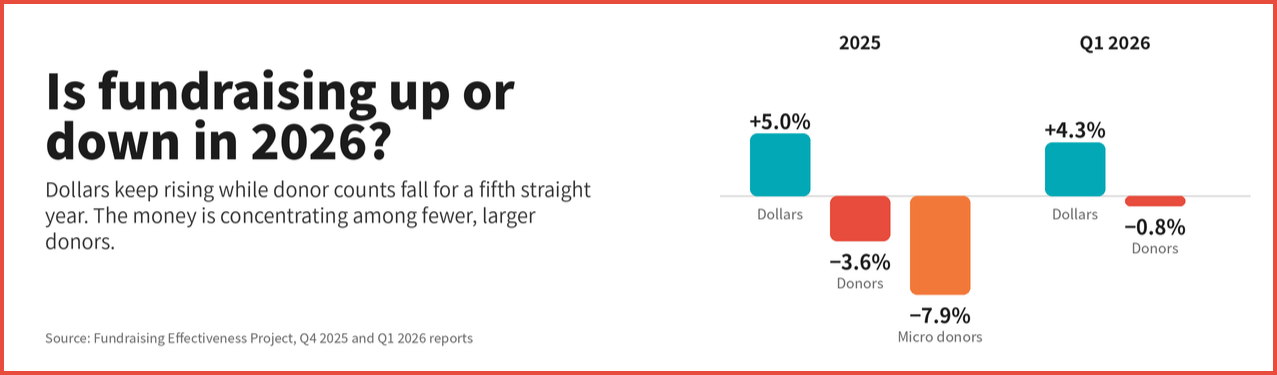
Nonprofit fundraising shows a similar trend. The Fundraising Effectiveness Project (FEP) reported that total giving to nonprofits grew 5.0% in 2025, the strongest revenue growth in five years, while the number of donors fell 3.6%, which marks the fifth straight year of losses. Micro-donors dropped 7.9% while larger donors supplied nearly all of the growth.
The first quarter of 2026 was a bit less brutal: donations rose 4.3%, but total donor counts unfortunately slipped by 0.8%. FEP also cautioned that part of the late-2025 surge may have been gifts pulled forward ahead of tax law changes, which would make the second half of 2026 harder than the first.
GivingTuesday 2025 shows what people do when a moment gives them a reason. It raised a record $4.0 billion, up 13% from 2024. So, the shortage is in new people who care about your cause.
Why are fundraisers raising more money from fewer donors?
Because the industry optimized for extraction. John Hall, who has helped raise more than $1.6 billion online over 15 years, laid out the diagnosis in a September 2026 interview with the Doomscroll newsletter: fundraising programs have perfected the craft of getting another gift from an existing donor while the skill of creating a brand-new donor has atrophied.
The pattern crosses party lines. Organizations have honed in on the hooks that raise the most money, leading them to optimize for the same shock-value content aimed at the same shrinking pool. Hundreds of individually rational decisions exhaust the market, and fundraising costs climb even as programs grow more efficient. Hall's summary of the limit: “You can't email and text your way out of nobody caring.”
The FEP data tells the nonprofit story, and its analysts point to the first-to-second-gift conversion as the pipeline's biggest unsolved problem.
What makes a new donor care enough to give?
You need to give a donor a reason to know you, trust you, and give them something to show for their attention before you ask. Hall argues that the funnel starts long before you acquire an email or phone number, and he criticizes the habit of jumping straight from a new phone number to a $25 request. He rightfully asks fundraisers to consider how their messaging addresses how this person knows who you are, why they care what you say, and what would keep them reading.
Asked whether he would rather have 500,000 email addresses or 100,000 engaged voters, he takes the 100,000, because you can later ask a person who wants to hear from you to donate, volunteer, attend, share, or vote. A planned sequence that starts weeks earlier, delivers something useful in each message, and earns the right to make the donation ask is “show me you know me” applied to donors.
Why does P2P texting fit a relationship-first fundraising sequence?
Texting is one of the only scalable mass communication channels that behaves most like a conversation… because you can actually have them! Texting puts a named sender on each message and turns each reply into data: tag the response, segment the list, and let the next message reflect what the person told you.
Delivery is the second reason. The Impressions to Ballots newsletter from Cross Screen Media put it plainly: “Very few media channels guarantee delivery to a voter.”
Frequency is the third. The same newsletter reported on a Battleground Impact test that sent video texts in one media market and nothing to a control market: ad recall rose 22 points, recall climbed with the number of texts a voter read, young voters (the group least likely to see a TV ad) showed the largest lift and ballot preference moved. The lesson holds for fundraising. Battleground Impact separately projects persuasion and mobilization texting as a $750 million market in 2026, roughly the size of direct mail.
Shared data is the fourth. Each reply becomes a record you can push to the rest of your program, which is where Impressions to Ballots ends up too: voter contact needs a holistic strategy with data that updates as new information comes in, so the event attendee, video viewer and eventual donor exist as one record.
How far ahead of a fundraising deadline should a texting sequence start?
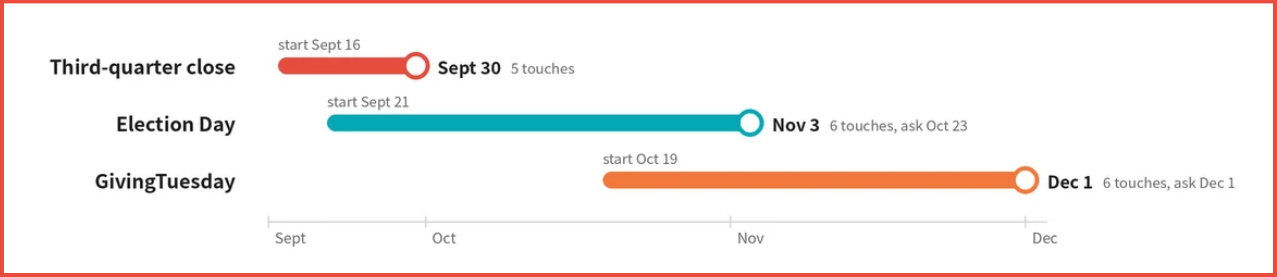
Strong texting sequences start three to six weeks out for the full six-touch sequence, and two weeks out for the compressed five-touch version. Our team recommends keeping roughly four value-giving messages for each individual fundraising ask.
|
Moment |
2026 date |
Start by |
Plan |
|
Third-quarter close (FEC period ends) |
Wednesday, September 30 |
September 16 |
Five touches, roughly one every four days, ask on September 30 |
|
Election Day |
Tuesday, November 3 |
Week of September 21 |
Six touches, ask at the final spend deadline (about ten days out), then turnout texts |
|
GivingTuesday |
Tuesday, December 1 |
Week of October 19 |
Six touches, ask on December 1, report on December 2 |
Why does the third-quarter close matter so much to campaigns?
When third-quarter reports are posted, party committees, reporters, outside groups, and donors compare what each campaign has in the bank, and the comparison doubles as a forecast (a campaign’s “reading the tea leaves”). A campaign holding $200,000 against an opponent's $50,000 looks like it has the edge in the final month, so money and attention follow it.
A strong end-of-quarter in September sets up for October, and every dollar raised goes into closing TV, digital, and get-out-the-vote operations. In that flood, people respond to the donation request that has an actual relationship behind it.
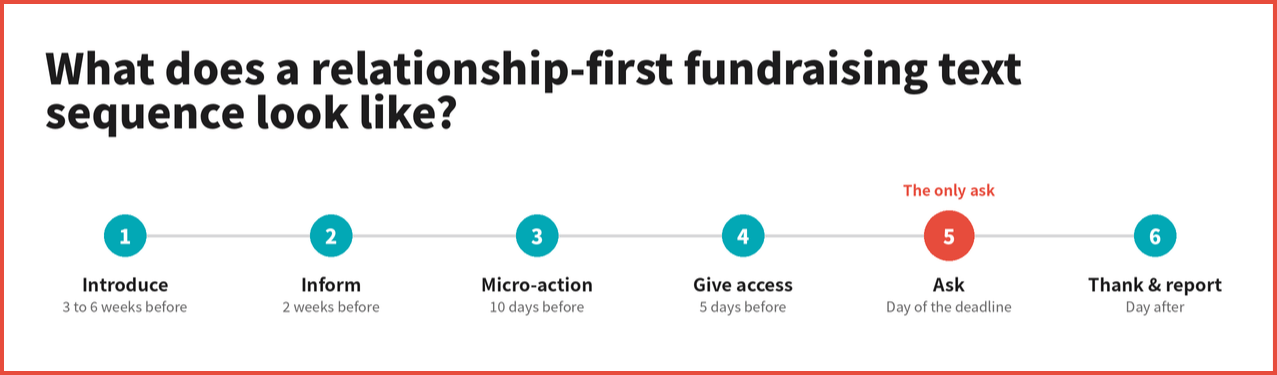
What does a relationship-first fundraising text sequence look like?
To build trust and “brand” recognition naturally, each message should do one job, and each reply should shape the next message.
|
Touch |
When |
Job |
What it earns |
|
1. Introduce |
Three to six weeks before your deadline |
Name the sender, say why this person is on your list and how often you will text |
Respect |
|
2. Inform |
Two weeks before |
One useful bit of information that is not easy to stumble upon, like a local issue update, early voting dates or a new tax rule |
Credibility |
|
3. Invite a micro-action |
Ten days before |
The goal is getting a reply, a one-question vote or an RSVP, with no dollar request attached |
Data and ownership |
|
4. Give access |
Five days before |
A short video from the candidate or program lead |
Trust |
|
5. Ask |
Day of the deadline |
One amount, one outcome, a deadline and a single link, referencing their touch 3 answer |
The gift |
|
6. Thank and report |
Day after |
Tell donors what their gift did and everyone else what happened |
The second gift |
Segment step #6 is one that most fundraisers still never implement to their detriment. Telling donors what their gift did and allowing non-donors to get the result with no ask attached keeps both groups reading in January.
For our specific message ideas outlined below, swap the bracketed placeholders for your own details and add the opt-out language and disclaimers your compliance counsel requires.
Political campaign before the third-quarter close (September 30)
Fourteen days is enough for the compressed five-touch version. The compressed version folds touches 1 and 2 into one message.
Touch 1 (September 16), introduce and inform
|
Hi [First Name], this is Libby, a volunteer with [Candidate] for [Office]. You're getting this because you vote in [County], where [Candidate] has spent 12 years as a [role]. One number for you: the average property tax bill here went up $[X] since 2022, and [Candidate]'s first bill would [action]. Plan: [link]. Have questions for [Candidate]? You can reply to me directly. |
Touch 2 (September 21), voter ID question
|
[First Name], quick one: can [Candidate] count on your vote in November? Reply 1 for yes, 2 for undecided or 3 for no. |
Touch 3 (September 26), candidate video for the yeses and undecideds
|
[Candidate] recorded 30 seconds for the [County] supporters and future-supporters like you who took the time to talk to our volunteers covering [Video topic]. Have questions about [Candidate]’s [Video topic]? Reply with a question and I'll get you an answer - we read every reply. |
Touch 4 (September 30), ask tied to the quarter close
|
[First Name], our third-quarter report closes at midnight, and the cash on hand we report is the number reporters, party committees and donors use to judge whether this race is winnable. [X] of your neighbors in [County] have given this quarter. Will you join them with $25 or what you are able before midnight? [link] Libby, [Candidate] for [Office]. Paid for by [Committee]. |
Touch 5 (October 1), thank you and report
|
Thank you, [First Name]. [Candidate] closed the quarter with $[X] on hand and [X] donors from [County], [X]% of them first-time givers. October is when that money goes to work, and I'll show you where [Show Spending Plan Via Attached Image]. |
Undecideds get the video with no ask, and non-donors get the report with no ask. If you run this sequence and also want to try the Election Day sequence below, start at touch 2.
Political campaign before Election Day (November 3)
Seven weeks out gives you enough time to implement the full six-touch version sequence outlined below. Time the ask to your last spend deadline, since a dollar that arrives on November 3 buys nothing. For most campaigns, that deadline is the final ad buy or text blast, placed roughly ten days out.
Touch 1 (September 22), introduce
|
Hi [First Name], this is Libby, a volunteer with [Candidate] for [Office]. You're getting this because you vote in [County], where [Candidate] has spent 12 years as a [role]. I'll text a handful of times before Election Day on November 3, and you can reply to me directly. Reply STOP to opt out. |
Touch 2 (October 6), inform with early voting dates
|
[First Name], dates from Libby with [Candidate]: early voting in [County] runs [start date] to [end date] at [locations], and the deadline to request a mail ballot is [date]. |
Touch 3 (October 13), one-question issue poll
|
Quick question, [First Name]: which issue do you most want [Candidate] fighting for? Reply 1 for the cost of living, 2 for public safety, 3 for schools or text me something else. Your answer decides what I send next. |
Touch 4 (October 20), candidate video matched to their answer
|
[First Name], you said [issue] matters most. [Candidate] recorded 30 seconds for the [County] voters who told us the same thing: [video]. |
Touch 5 (October 23), ask tied to the final ad buy
|
[First Name], our final ad buy gets placed Monday, and what we can afford depends on tonight. A donation of [$X] from you puts [Candidate]'s closing ad in front of [X] more [County] voters in the last week. Would you consider chipping in before midnight? [link] |
Touch 6 (October 24), thank, report and collect a voting plan
|
Thank you, [First Name]. The buy is placed, and [X] neighbors from [County] made it possible. Early voting opens [date] at [location]. Reply 1 if you'll vote early, 2 by mail or 3 on Election Day and I'll send the right reminder. |
From October 25 through November 3, the list receives turnout texts matched to that reply.
Nonprofit before GivingTuesday (December 1)
Eleven weeks out, you have the full sequence and a tax fact new this year. Starting with the 2026 tax year, donors who take the standard deduction can deduct up to $1,000 (single) or $2,000 (joint) in cash gifts to qualifying 501(c)(3) charities. It excludes donor-advised funds; confirm specifics with your tax advisor.
GivingTuesday donors also stick: the Blackbaud Institute and GivingTuesday found 65% of 2024 GivingTuesday donors gave again in 2025 versus 52% of donors acquired earlier in the year, and recurring plans surged on GivingTuesday 2025 (up 25% on GoFundMe Pro and 66% on Bloomerang), so touch 6 offers the monthly option.
Touch 1 (October 20), introduce
|
Hi [First Name], this is Marcus with [Org]. Our mission is to [Explain Mission] and we hope you will consider supporting us. Expect a few texts from me between now and December 1. |
Touch 2 (November 3), inform with the new deduction
|
[First Name], this is Marcus again from [Org] with an exciting update: starting with your 2026 taxes, cash gifts to a 501(c)(3) like [Org] are deductible up to $1,000 ($2,000 filing jointly) even if you take the standard deduction. Worth a question to your tax preparer. Details: [link] |
Touch 3 (November 10), program vote
|
Quick vote, [First Name]: our GivingTuesday match will go to one program. Reply 1 for [Program A] or 2 for [Program B]. For more information on the programs and what happens when one wins, visit our explainer page: [Link]. I'll tell you which one wins when all the votes are in! |
Touch 4 (November 24), program lead video during Thanksgiving week
|
[First Name], Happy Thanksgiving from all of us at [Org]! [Program A/B] won the vote, [xx%] to [xx%]. [Name], who runs it, recorded 40 seconds for the people who voted to explain what they will do with the generous matched donor funding: [video]. |
Touch 5 (December 1), ask with the match
|
It's GivingTuesday, [First Name], and [Matching donor] is matching every gift to [Program A] until midnight. Your $[X] becomes $[2X], which covers [one unit, such as a week of meal kits for one family]. Give here: [link] Marcus, [Org] |
Touch 6 (December 2), thank, report and offer monthly
|
Thank you, [First Name]. [X] donors gave $[Y] yesterday, the match doubled it and [Program A] is funded through [month]. That's [Z units]. If you'd like to keep it funded past [month], $[X] a month does it: [link] |
How do you turn a first gift into a second?
The key IS the conversation - replying back to every person who writes back (hopefully the same day) lets them know their voice matters and that their money may actually be going to a real place. Hall's rule for new donors is to stop treating them like a cash machine. Say thank you, share what their money did, let them behind the curtain, and keep track of their history with you.
In practice, that means three habits inside your texting program.
-
Tag every reply that is not STOP, which is a courtesy your texting vendor’s software should honor instantly. This allows conversations to turn into targeted segments for hyper-personalized future outreach.
-
Answer quickly, in the sender's voice. Pre-written Tap-then-Send replies let volunteers respond to common questions in seconds without going off-message.
-
Report back to non-donors too. The supporter who read six messages and gave nothing is your best prospect for the next giving day.
Bottom Line
Start your outreach before you need the money, and show the prospective donor why they should give to your cause or campaign instead of demanding it. You have 14 days until the quarter closes, seven weeks until Election Day and 11 weeks until GivingTuesday.
Would you like a one on one strategy session to turn these plans into action? Book a 30-minute planning call with our team and leave with a send calendar, six drafted touches in your voice and 10DLC registration underway (if you have not already registered).
 9 minute read
.png)