6 minute read
How to Use P2P Texting After Election Day: Your Nov. 4th Plan, Win or Lose
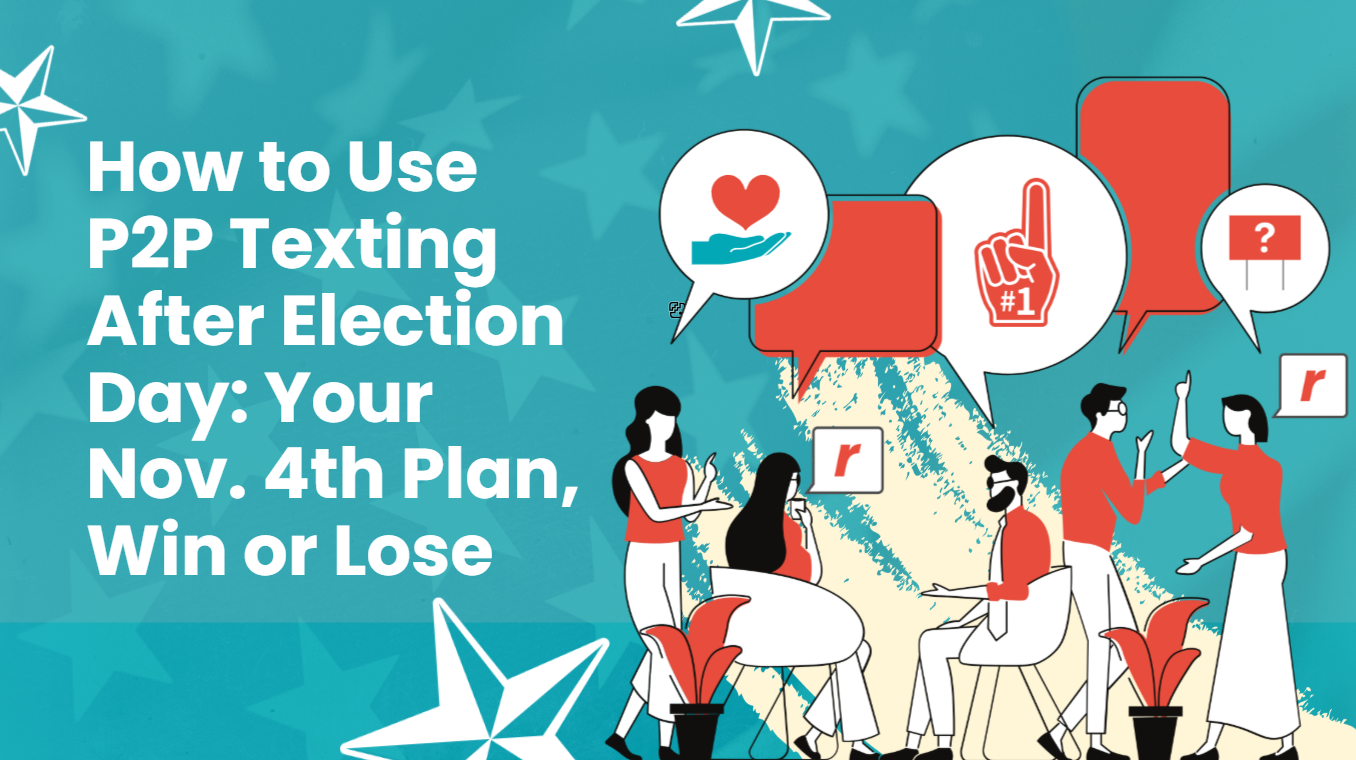
What to text donors, volunteers, and supporters in the first 72 hours after Election Day, and a 60-day timeline to keep your list alive into 2027
Within 72 hours of the polls closing on November 3rd, three groups need a text from you, win or lose: your donors, your staff and volunteers, and your supporters.
-
Donors hear what their dollars paid for in the final sprint, then get one ask a few days later for a gift that retires campaign debt
-
Staff and volunteers get an Enhanced Video Text with the candidate's personal thank-you before the moment fades
-
Supporters get proof that your promises outlast the campaign, starting with issue updates and calls to action on the measures coming in 2027
Let the list you built this cycle go quiet, and you pay full acquisition price to get the same people back in 2027 and 2028. Here is the peer-to-peer (P2P) texting plan for Wednesday morning.
Why does your campaign list lose value the day you stop texting it?
Thousands of cell numbers, each one attached to a person who gave, knocked, hosted, replied, or asked for a yard sign, will be sitting in your account on Wednesday. Leave that list alone until next year or your next cycle, and it depreciates in three ways.
-
The first text after a long silence earns the most opt-outs, because the recipient hasn't heard from you and the conversation has gone cold
-
Your 10DLC registration, the carrier approval that lets your texts send at all, carries a monthly fee. Cancel it to save that fee and face approval timelines next time you try and send
-
Donors are scarcer every year. The Fundraising Effectiveness Project counted a 3.6% drop in the number of donors in 2025, the fifth straight year of losses, even as dollars rose 5.0%. The people who gave to you this cycle are harder to replace than they were in 2022
How can a campaign keep engaging donors post-election?

Split your outreach into two texts sent a few days apart. The first text thanks donors and reports results, and the second is the final ask to clear any campaign debt.
Donors who hear what the money bought give again. Donors who get an ask on Wednesday, before you have thanked them, opt out.
Create three donor segments in your CRM before proceeding:
-
Maxed-out donors for the general election, who get a thank-you and nothing else
-
Active donors who have not maxed out, thank-you first, and the ask a few days later
-
Lapsed donors, meaning anyone who gave earlier in the cycle and nothing in the final 60 days, who get the thank-you and a smaller ask
There is a legal reason for the first segment. A contribution toward general-election debt counts against the donor's $3,500 per-election limit, which means a maxed-out donor cannot give again toward it. State and local races run on their own limits, worth a check before you build the list.
The report text, Thursday, November 5th
If you won: "We won! Gifts like yours paid for the last stretch of doors in [Location], so we could keep chasing every vote till the end. Thank you for everything, [First Name]."
If you lost: "[First Name], we came up short last night, but your gifts still paid for the last stretch of doors in [Location]. Your vital support gave us a fighting chance against [Opponent], and we are eternally grateful for your faith in our campaign’s vision till the end."
The ask text, week of November 9th
This one goes only to the donors with room under the limit.
"[First Name], the last invoices from our final push came in this morning, $[total] between them. [Candidate] wants to ensure these talented, hardworking partners are paid in full for their great work. Would you consider a final donation of $[amount] to help us close the books? [donation link]"
The donor sequence we published in September uses the same structure for a Q3 close and for GivingTuesday, and it holds up here.
Non-responders to this week’s text get one more reminder text the week of November 16th with the same amount and same link.
How do you send staff and volunteers a personal thank-you from the candidate?

The video is the easy part. Recording it early enough is the hard part.
-
Record it election night, or bright and early on Wednesday morning
-
Thirty seconds on a phone held vertically, no script, and caption it, since many people watch with the sound off
-
An Enhanced Video Text plays inside the thread, which spares a tired volunteer the tap and redirection to a video hosting site
If you won: "[First Name], this is the video [Candidate] shot at 11:40 last night in one take - [Candidate] was too excited to wait until morning to thank everyone who made this win possible!"
If you lost: "[First Name], [Candidate] recorded this bittersweet message for everyone who put their time and energy into this campaign. We didn't get the results we were hoping for, but the work you did mattered not only to [Candidate], but to our wider community. Watch when you are ready."
How do you keep supporters engaged on the issues coming in 2027?

Your supporters likely signed up, backed, and voted for your candidate over an issue, and that issue deserves the spotlight after the campaign ends. Texting them issue updates and calls to action on the measures coming in 2027 is how you prove the promises you made about that issue outlast the campaign. Three important dates:
-
January, when the legislature convenes
-
Spring, which is budget season and when most issue votes land
-
Whatever filing deadline a 2027 ballot measure in your state carries
Two sends between now and New Year's Day carry your list across that gap.
Send 1, the issue-update-inquiry (Friday, November 6th)
"[First Name], [Candidate] is sworn in January [X] and [issue] is first on the desk, which you indicated passion for during their campaign. Want a text before each vote that moves it? Reply YES, or STOP."
Tag each YES in the CRM as a 2027 legislative session subscriber. We recommend setting up a Drip Campaign that fires when a contact joins a group or replies with a specific keyword, so a YES dropped into a 2027 Subscribers group starts its own sequence. Set it up while someone still knows the platform and list.
Send 2, the first issue primer (mid-December)
"[First Name], I am filing [bill number] to [outcome]. Session opens January [day]. Reply 1 if you want hearing alerts on this bill, 2 for [issue B], 3 for [issue C]."
From there, one update or hearing alert a month starting in January is enough to make sure your list does not wear out before the session does.
What extra post-election housekeeping can you also tackle with texting?

One major chore remains for most campaigns after Election Day, and it shapes how the district remembers you: collect your yard signs.
Within the week, text two groups: the supporters who hosted a sign and the volunteers who planted them.
-
Hosts get a text that explicitly states a time and date for sign collection, like "We will come by Saturday between 9 and noon to grab the sign, or leave it by the mailbox and reply DONE."
-
For signs placed along public right-of-way (which campaigns usually do not keep records of), ask volunteers to reply with the cross streets where they put signs; that becomes the pickup route.
Many cities set a removal deadline a week or two out, and some fine the campaign per sign, so this text saves both money and goodwill.
What does a 60-day post-election texting timeline look like?
Most of the 60 days is quiet, with the busiest time in week one.
-
November 4th - 6th are when the opening sends go out: the candidate's thanks to donors and volunteers first and the supporter issue-update-inquiry last. Yard sign pickup texts go out in the same window.
-
November 9th - 10th, the debt-retirement ask goes to donors with room under the limit, and one reminder follows the week of November 16th.
-
Mid-December brings the first 2027 pre-session issue primer from the Drip Campaign, and the monthly cadence of issue updates starts in January.
Bottom Line
Win or lose, your texting list is one of the only campaign assets that outlasts Election Day, and it holds that value only as long as someone texts it.
Would you like help mapping these sends? A RumbleUp strategist can be your second set of hands after Election Day. Book a 30-minute planning call with our team and leave with segments sized, win or loss versions of each text drafted in the candidate’s voice, and the Drip Campaign for your 2027 audience planned before anyone on staff leaves. If you manage texting for several campaigns, bring the roster; the same templates run in every account.
Let's Rumble 🥊
______________________________________________________________
Post-Election Texting FAQs
How soon after Election Day should a campaign text its supporters?
Within 72 hours. The candidate's video goes to staff and volunteers on Wednesday, November 4th, or Thursday if the candidate records Wednesday morning. Donors hear Thursday. Every opted-in supporter hears by Friday, November 6th.
Can a campaign ask donors for money after losing?
Yes. A committee that lost can keep raising money to retire net debts outstanding from the election, and at the federal level each of those contributions counts against the donor's $3,500 per-election limit. Thank first, show what the money did, then ask once with one amount and one outcome.
How often should you text supporters between elections?
One a month, each hung on a hearing, a vote, or a filing deadline (the cadence you promised in the opt-in text overrides mine).
Why does the day after Election Day matter for texting specifically?
Meta's restriction period is set to end November 3rd, but in previous years, they kept similar restrictions running for days afterward. Google also switched off election ads once polls closed in previous cycles. A text has no such problem.
 6 minute read