
 5 minute read
How Bondar for Congress Used P2P Texting to Reach Texas CD32 Like a Neighbor
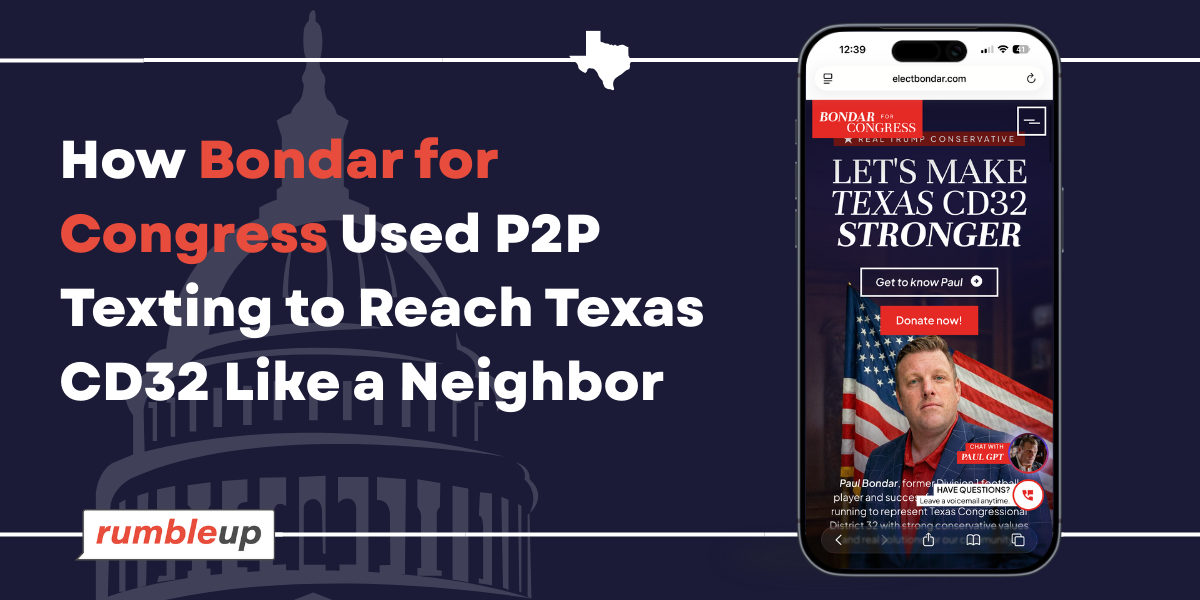
In a crowded race, most campaigns treat peer-to-peer (P2P) texting like a mini press release: one message, one angle, one list.
Bondar for Congress took a different path. The campaign used mass media for broad positioning, then reserved texting for the most personal content in the mix: the kind of messages that sound like they came from someone you might see at church, on the lake or at a Friday night game.
That “neighbor, not candidate” approach did not happen by accident. It came from disciplined list segmentation, intentional content choices and a clear decision about what texting should do that billboards and streaming ads cannot.
Campaign snapshot
Paul Bondar is running to represent Texas Congressional District 32 and positions himself as a local, non-insider option, noting that he lives in the district and can vote for himself.
The district recently shifted under new lines, combining fast-growing suburban areas with long-established rural communities across North and East Texas.
The campaign’s core communications insight is that mass media builds awareness, but texting builds familiarity. Bondar for Congress is using each channel for what it does best.

The challenge
Voters are drowning in “candidate voice”
In Texas CD32, voters see and hear same-cycle messaging everywhere: billboards, streaming, social and inboxes. The problem is not message access. The problem is message sameness.
The Bondar team saw a specific risk with texting: if a message leans too hard on national politics and generic issue framing, the candidate’s name disappears into the noise.
A new map makes “local trust” more valuable
With the district expanding across multiple counties and communities, voters do not just need issue alignment. They want reassurance that the person asking for their vote understands the district firsthand.
Why texting, not just ads
Bondar for Congress did not use texting as a “cheaper billboard.”
The campaign treated texting as the most intimate voter-contact channel available at scale: a direct message that lands in the same place voters talk to their family and friends. That creates a high bar for tone. If the message does not feel human, it fails fast.
The strategy
Two lanes, two jobs
Lane 1: Mass media for positioning
- The campaign invested heavily in name awareness and baseline positioning through billboards and streaming.
- The team referenced 35 billboards and a significant billboard spend, using simple positioning language like “Trump conservative.”
Lane 2: Texting for relationship
- Texting carried the personal story: family moments, community references and “small proof” that Paul Bondar lives the same life the voter lives.
- This matched the campaign’s broader “local, accountable, not a political insider” framing across its website and content.
The key tactic: segment like you mean it
Many campaigns blast one message to every number they have.
Bondar for Congress segmented the master universe into smaller, specific groups so each text could sound relevant and earned. The campaign team highlighted list breakdowns, such as “Rockwall Individual Voters” and interest-driven sends rather than “send to everyone.”
This was not segmentation for the sake of segmentation. It was segmentation to protect tone.
What made it “neighbor texting”
Bondar for Congress built a repeatable playbook that other campaigns can copy.
1) Use personal content as your engagement unlock
The team saw a consistent funnel:
- Generic political texts produced low engagement
- Personal texts produced meaningful replies
Two examples became the clearest proof points:
The Rockwall fishing message
- The campaign identified voters who liked fishing and sent a fishing photo specifically to that segment (about 11,000 people).
- The point was not persuasion in one message. It was familiarity: “I am a person you recognize.”
- The campaign team explicitly framed this as relationship-building, even when voters pushed back.
.png?width=807&height=558&name=Bondar%20for%20Congress%20use%20case%20-%20Images%20(1).png) Real Text Message
Real Text Message
The Christmas family video
- The campaign sent a Christmas message featuring the family, which drove a wave of positive replies compared to earlier, more political texts.
- One detail mattered: Paul invited voters to come to his church. That sparked roughly 75 inbound questions asking which church it was, giving the team a natural, neighbor-to-neighbor response.
.gif?width=482&height=334&name=Bondar%20for%20Congress%20use%20case%20-%20Images%20(1).gif) Real Text Message
Real Text Message
This is the “neighbor” advantage in one moment: voters do not ask follow-up questions when your text reads like a mail piece.
2) Treat texting as a thread, not a one-off blast
The campaign did not just send standalone messages. The team watched how contacts moved through a sequence: early mass positioning, then more personal content, then issue testing.
That thread-based view helped them spot who stayed quiet and who eventually replied once the content felt human.
3) Protect your high-engagement people from avoidable churn
The team considered an issue-based message as a quick pulse check, then debated whether to send it broadly, since divisive content can flip an engaged contact in an instant.
Instead, they discussed pulling highly interactive voters into a separate list so future outreach could stay personal, consistent and trust-building.
This is advanced campaign texting: you stop treating every voter as the same kind of audience once they raise their hand.
4) Tag and sort replies into a real pipeline
Bondar for Congress used replies to do real organizing work: tagging voters as “strong support,” “lean support,” “undecided persuasion,” “strong opposed,” capturing emails and planning follow-up.
That turns texting into more than voter contact. It becomes list refinement, supporter identification and volunteer and donor prep in the same motion.
The content engine behind the texts
“Neighbor texting” only works if you have neighbor content.
Bondar for Congress built a deep bench of material that supports personal outreach:
- A biography rooted in family and day-to-day life, including stories that translate naturally into MMS
- A detailed “I am” values statement written in first person, which gives the team authentic language to pull into short-form texts without sounding manufactured
- A legacy-of-service section with specific documentation and artifacts, giving the campaign credible, verifiable story content that voters can explore
- Background details that make outreach feel local and specific
The campaign also highlighted the value of video assets sized correctly for texting, including a 30-second spot that can live in a message thread.
Results and indicators of success
Bondar for Congress measured success the way serious texting programs should: not just volume, but the quality of responses and what they unlocked.
What changed when the campaign texted “like a neighbor”
- Personal MMS and video content generated noticeably stronger reply volume and positivity than generic political messaging.
- The Christmas outreach sparked genuine two-way conversations, including dozens of organic follow-up questions that opened the door to deeper engagement.
- The team identified a clear “high engagement” cohort and began planning a separate segmentation track to convert replies into volunteers and grassroots donors.
Scale
- The campaign referenced sending roughly 192,000 to 205,000 texts in a short period and projected total volume could exceed one million as activity accelerates.
What other campaigns should steal from this playbook
1. Decide what texting is for - If you use texting for the same content as your mail and digital, you waste the channel.
2. Segment beyond geography - Geography matters. Interests matter too. A fishing segment beat a generic blast because it matched identity, not just location.
3. Send proof-of-person messages - Voters do not build familiarity with policy paragraphs. They build familiarity with specific, personal details.
4. Build a high-engagement track - Once a voter replies, stop treating them like a cold contact. Protect them from random message swings.
Bottom line
Bondar for Congress proves a point that many campaigns miss: you do not win trust by sounding like every other candidate. You win it by showing up like someone who lives there.
Billboards and streaming ads can tell voters who you are. P2P texting can make voters feel like they know you. Bondar for Congress built that familiarity by aggressively segmenting, sending personal MMS and video content and treating replies as the start of a relationship rather than a distraction.
If you want to build a texting program that sounds like a neighbor and scales like a serious campaign operation, RumbleUp gives you the infrastructure to segment cleanly, handle high-volume two-way conversations and keep message quality consistent.
 9 minute read

.png)